Designing RESTful APIs: Best Practices
RESTful APIs power modern applications, from mobile apps to distributed systems. While building an API is straightforward, designing one that is clean, scalable, and intuitive requires discipline.
This article highlights the essential best practices for designing RESTful APIs.
1. Design Around Resources
APIs should expose resources (nouns), not actions.
Bad:
/createUser
/getUser?id=1
Good:
POST /users
GET  /users/1
Let HTTP methods define the action.
2. Use HTTP Methods Correctly
| Method | Purpose |
|---|---|
| GET | Read |
| POST | Create |
| PUT | Replace |
| PATCH | Update |
| DELETE | Remove |
Clear semantics make APIs predictable.
3. Use Clear and Consistent Naming
- Use plural nouns (
/users)
- Keep URLs lowercase
- Avoid file extensions
Example:
/users/1/ordersConsistency matters more than style.
4. Return Proper HTTP Status Codes
Status codes are part of your API contract.
200 OK– Success
201 Created– Resource created
400 Bad Request– Invalid input
404 Not Found– Missing resource
500 Internal Server Error– Server failure
Never return `200` for errors.
5. Keep Responses Consistent
Use a predictable structure.
{
  "data": { "id": 1, "name": "Alice" }
}
For errors:
{
  "error": { "code": "INVALID_INPUT", "message": "Email is invalid" }
}
6. Support Pagination and Filtering
Avoid returning large datasets.
GET /users?page=1&limit=20
GET /orders?status=shipped
This improves performance and scalability.
7. Version Your API
APIs evolve—clients should not break.
/v1/users
/v2/users
Versioning protects backward compatibility.
8. Keep APIs Stateless and Secure
Each request must include all required context.
- Use HTTPS
- Authenticate every request
- Validate inputs
- Apply rate limiting
Stateless APIs scale better and are easier to maintain.
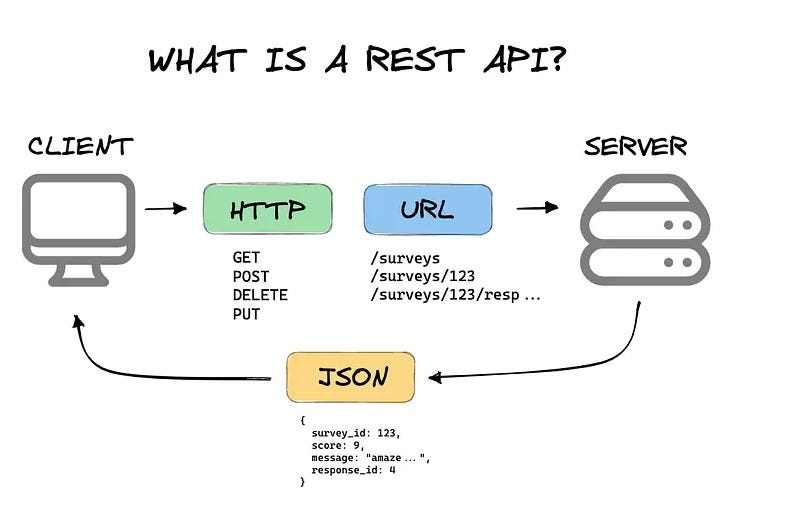
REST API Flow Overview
The typical REST API flow involves:
- Client sends an HTTP request with a method (GET, POST, PUT, DELETE) to a specific URL endpoint
- Server receives the request and processes it based on the HTTP method and resource
- Server returns a response in JSON format with appropriate status code
- Client receives and processes the JSON response
Example flow:
- Client:
GET /surveys/123/responses
- Server processes and returns:
{ "survey_id": 123, "score": 9, "message": "amaze...", "response_id": 4 }
Final Thoughts
A good RESTful API is:
- Easy to understand
- Consistent to use
- Safe to evolve
Design APIs with long-term usability in mind—your future users (and future you) will thank you.